Do you want to receive updates about our news and promotions?

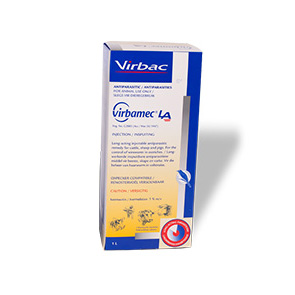
Virbamec LA 1L
Rated 5 out of 5 based on 9 customer ratings
$ 99.82
Description FOR ANIMAL USE ONLY CAUTION CHEMICAL GROUP: ①† † Macrocyclic Lactones OXPECKER COMPATIBLE COMPOSITION: Ivermectin 1 % m/v DIRECTIONS FOR USE: Use only as directed Do not use intravenously. Use of a 2,0 cm 16 gauge needle is recommended. The solution may be administered with any standard automatic or single-dose equipment. Cattle: Inject subcutaneously or intramuscularly at 1 ml per 50 kg body mass. Inject subcutaneously under the loose skin in front of or behind the shoulder. Appropriate vaccination precautions should be taken in areas where the risk of clostridial infections such as black quarter (sponssiekte) and malignant oedema are present. Sheep: Inject subcutaneously only at 1 ml per 50 kg body mass. The loose skin of the sheep behind the shoulder is an acceptable site. Other administration sites are the skin under the foreleg (axilla) and the inside of the thigh. Ensure that the needle is carefully inserted and that the solution does not leak from the injection site. In wool sheep, ensure that the needle has penetrated the wool and skin before the dose is delivered. Sheep scab: Sheep scab is a notifiable disease and treatment of suspected or confirmed outbreaks must be under government supervision. One treatment of Virbamec LA at a dose rate of 1 ml per 50 kg body mass by subcutaneous injection will eliminate the infestation. Ensure by proper management and supervision that all sheep on the farm are treated at the same time during an outbreak of sheep scab. Sheep scab in Namibia: Even though this remedy is registered in South Africa for only one treatment, the law in Namibia states that two treatments, 7 – 10 days apart, are obligatory in the event of a sheep scab outbreak. Pigs: Inject subcutaneously or intramuscularly at 1 ml per 33 kg body mass. Do not use intravenously. Ostriches: Inject subcutaneously only. The recommended dose is 1 ml per 50 kg body mass for the control of ostrich wireworm (Libyostrongylus douglassii). DOSAGE TABLE Body mass (kg) Dose (ml) CATTLE CATTLE Up to 50 1 51 – 100 2 101 – 150 3 151 – 200 4 201 – 250 5 251 – 300 6 301 – 350 7 351 – 400 8 SHEEP SHEEP Up to 25 0,5 26 – 50 1,0 51 – 75 1,5 76 – 100 2,0 PIGS PIGS Up to 33 1 34 – 66 2 67 – 99 3 OSTRICHES OSTRICHES Up to 50 1 51 – 100 2 101 – 150 3 151 – 200 4 EFFICACY: 1. Internal Parasites CATTLE Roundworms: Immatures Adult Persistency Wireworm (Haemonchus placei) including inhibited larvae * * 35 days Brown Stomachworm (Ostertagia ostertagi) including inhibited larvae * * 35 days Bankruptworm (Cooperia spp.) * * 28 days Hookworm (Bunostomum phlebotomum) * * 42 days Nodular worm (Oesophagostomum radiatum) * * 49 days Lungworm (Dictyocaulus viviparus) * * 21 days Eyeworm (Thelazia spp.) * Long-necked bankruptworm (Nematodirus spp.) * White bankruptworm (Strongyloides papillosus) * Ascarids (Toxocara vitulorum) * False bruising (Parafilaria bovicola) * Definition: * Control (≤90 % effective) SHEEP Roundworms: Immatures Adult Wireworm (Haemonchus contortus) * * Nooitgedacht resistant wireworm strain (Haemonchus contortus) ** Brown Stomachworm (Teladorsagia spp.) * * Bankruptworm (Cooperia spp.) * * Hookworm (Gaigeria pachyscelis) * * Nodular worm (Oesophagostomum spp.) * * Large-mouthed Bowelworm (Chabertia ovina) * * Lungworm (Dictyocaulus filaria) * * Long-necked bankruptworm (Nematodirus spp.) * * Whipworm (Trichuris spp.) * White bankruptworm (Strongyloides papillosus) * * Definition: * Control (≤ 90 % effective) ** Aids in control of (60 – 89 % effective) PIGS Roundworms: Immatures Adult Ascarids (Ascaris suum) * * White bankruptworm (Strongyloides ransoni) * * Nodular worm (Oesophagostomum spp.) * * Lungworm (Metastrongylus spp.) * * Whipworm (Trichuris spp.) * Definition: * Control (≤ 90 % effective) OSTRICHES Roundworms: Immatures Adult Ostrich wireworm including inhibited larval stages (Libyostrongylus douglassii) * * Definition: * Control (≤ 90 % effective) 2. External Parasites CATTLE Virbamec LA kills: Sucking lice (Linognathus vituli, Solenoptes capillatus, Haematopinus eurysternus); Biting lice (Damalinia bovis); Warble flies (Hypoderma bovis, H. lineatum); Mange mite (Psoroptes bovis, Sarcoptes scabei var. bovis, Chorioptes bovis); Sand tampans (Ornithodoros savignyi); Cattle screw-worm (Chrysomya bezziana) Blue tick (Boophilus spp.): Controls blue ticks for up to 42 days SHEEP Virbamec LA kills: Sheep scab mites (Psoroptes communis var ovis); Sarcoptic mange mite (Sarcoptes scabei var ovis); Australian itch mite (Psorergates ovis); Sucking lice (Linognathus spp.) PIGS Virbamec LA kills: Sucking lice (Haematopinus suis) Mange mites (Sarcoptes scabei var. suis) with persistent activity for 56 days 3. Nasal worm (Oestrus ovis) Sheep: Controls all stages (1st, 2nd and 3rd instar larvae) WARNINGS: Cattle, sheep and pigs must not be slaughtered for human consumption within 42 days of last treatment. Ostriches must not be slaughtered for human consumption within 14 days of last treatment. Do not use in lactating cattle or sheep where milk or milk products are used for human consumption. Do not use in dairy cattle within 42 days before calving where milk and milk products are intended for human consumption. Do not administer intravenously in cattle, sheep and pigs. Do not administer intramuscularly in sheep. Ostriches to be injected subcutaneously only. Do not inject intravenously. Keep out of reach of children, uninformed persons and animals. Although this remedy has been extensively tested under a large variety of conditions, failure thereof may ensue as a result of a wide range of reasons. If this is suspected, seek veterinary advice and notify the registration holder. PRECAUTIONS: Do not re-use empty bottles. Drug containers and any residual contents should be disposed of safely (e.g. by burying or incinerating), as free ivermectin may adversely affect fish and certain water-borne organisms. When ivermectin comes into contact with the soil, it readily and irreversibly binds to the soil and becomes inactive over time. Do not smoke, drink or eat while handling the product. Wash hands thoroughly after use. Use sterile equipment and follow aseptic procedures. Do not dilute or mix with any other substances. Vaccination of cattle against clostridial infections (eg. black quarter) is strongly recommended. Sheep should be vaccinated against pulpy kidney (enterotoxaemia) before treatment. STORAGE INSTRUCTIONS: Store at room temperature below 30°C. Protect from light. PRESENTATION: 10 ml, 50 ml, 500 ml and 1 L polyethylene bottles
Categories: Leggings, Home Gym, Ignition Coils,

The advantages of the wine boxes
Our Bag in Boxes are a triumph of technology, bringing top class wines to you for regular everyday consumption, without having to open a new bottle when you just fancy a glass or two!
Once opened, the bag in box will keep between four and six weeks, longer if stored in the cool. The white wines are best stored in the fridge for the ultimate taste and freshness. The bag in box is not designed for long term ageing or storing.
The Organic bag in box comes in eco-friendly packaging that generates up to 8 times lower carbon footprint than glass bottles and it is easily recyclable.

Once opened, the bag in box will keep between four and six weeks, longer if stored in the cool. The white wines are best stored in the fridge for the ultimate taste and freshness. The bag in box is not designed for long term ageing or storing.
The Organic bag in box comes in eco-friendly packaging that generates up to 8 times lower carbon footprint than glass bottles and it is easily recyclable.